He was applying mature themes and storylines to the superhero genre, asking the question "What would someone who put on tights and beat people up really be like?". He turned Daredevil, a title on the brink of cancellation, into one of the hottest selling books of the era and elevated DD to the status of an A-list Marvel hero, thanks to his stylish, film-noir influenced take on the character.
Even more famously, Miller went on to write and draw the classic graphic novel The Dark Knight Returns, a dystopian future look at the Batman, filled with political satire and sensitive characterization - as well as crowd-pleasing action. He followed this up with another landmark Batman comic Batman: Year One, which re-examined and modernized the character's origins. (Year One was a big influence on Christopher Nolan's Batman Begins.) Then he went back to Marvel to pen another classic Daredevil comic, the landmark "Born Again" storyline.
Miller then struck out into the world of creator-owned comics, most notably his stylish "hyper-noir" comic series Sin City, which is pretty much the apotheosis of Miller's style, both his style of writing and his artistic style, which had both been continually evolving since the 1980s.

A cover to Sin City, featuring the iconic character of Marv, by Frank Miller.
Arguably, he's been on a downward spiral ever since, and I'd argue its because he's basically forgotten how to write anything EXCEPT Sin City. There are a couple of stylistic tics that have always been present in Frank Miller's work:
- the protagonist is a tough-talkin guy in a trenchcoat (or a cape). This character is usually a loner or an outcast or a social misfit. Often, said protagonist is cheerfully insane and violent, but kind of loveable anyway. Marv, from Sin City is a perfect example, as is Batman
- the women are
a) hyper-sexualized femmes fatales who use their feminine wiles to achieve their aims. They're cast as just as tough as the men in the story, often skilled martial artists, or out and out psychos. HOWEVER, they still need rescuing, by and large. And these women are often literally (or figuratively) whores. Examples include Seline Kyle in Batman: Year One, Elektra, and every Oldtown girl in Sin City, including Gail.
b) saints. Sometimes literally. Women who are entirely perfect and flawless, a kind of Madonna figure. Daredevil's mother and Bruce Wayne's mother are the most prominent examples.
- the setting. A grim, dark urban hellhole - the worst excesses of city life magnified. Crime and corruption are rampant. It's never sunny or cheerful - in fact, it's usually raining. Gotham and Sin City spring to mind.
- the dialogue is sparse, terse and full of what can only be termed machismo. Stylization, repetition and hyperbole are the order of the day.
Now, by no means am I suggesting that any of these qualities necessarily make Frank Miller a bad writer. Because I actually think that his stuff from the 1980s holds up really well, and taken in the context of what he's trying to achieve, so does Sin City. But that's because his work from the eighties has substance to compliment Frank Miller's style. Miller creates complicated, ambiguous and interesting heroes, and his prose often has a reverent mythic quality. Indeed, Miller is well known for treating superheroes as living modern myths, and in that context, the hyperbolic quality of his prose makes a lot of sense.
It seems to me that in the last fifteen years or so, the intelligent, literary qualities of Miller's work have largely evaporated, leaving behind … what? A hyper-masculine, reactionary, misogynist body of work, pretty much devoid of real artistic merit.
As an example, I'll compare Frank Miller's Dark Knight Returns with his much more recent (and still-unfinished series) All Star Batman and Robin the Boy Wonder.

The Dark Knight Returns
It's theme remains groundbreaking - Cold War paranoia doesn't stop being relevant just because the Cold War's over. Otherwise, you might as well say the same of Watchmen. Furthermore, the central theme of Batman's journey - a man struggling to reconcile his past with the present, an old man trying to recapture his days of glory, an old soldier seeking a glorious death, the last stand of a once-mighty hero - those things never go out of style. Indeed, this is Frank Miller's attempt to craft a worthy end to Batman, in the vein of King Arthur's climactic battle with Mordred, or an elderly Robin Hood firing one last arrow into the Sherwood Forest to mark the site of his grave. These themes are ever present, woven into the super-heroic narrative.
In terms of plot, the four acts could not be more skillfully paced and structured:
Act 1: We establish the future-Gotham, and the state of our main players. The first chapter not only reflects the incurability of evil, but also the inevitable return of Bruce Wayne's own obsessive-compulsive nature. One of the things I love best about DKR is the interesting look at Batman's psychology. Miller's Batman is not necessarily a hero because he wants to be - but because he is compelled to be. Seeing his parents die drove him a little bit nuts, and the way he copes is by dressing up as Dracula and beating the crap out of people. Without that release, he has no direction and no purpose. So an elderly Bruce Wayne simply can't stay retired - and his return to prowling the rooftops of Gotham coincides with the resurrection of one of his deadliest adversaries - who also struggles with a split personality he cannot control.
Act 2: In this, we see the establishment of what might be the new 'status quo' of the DKR world - if it were not doomed to eventual destruction by the intervention of Superman. Batman encounters a new menace - one for which he is not wholly prepared - and he has to adapt his methods to cope. He's not a young man anymore - but he's still Batman. This chapter also fleshes out the supporting cast (Jim Gordon, Robin, Alfred) and the larger political environment Batman finds himself in. Here Miller satirizes the state of the media in the 1980s (and it's still a pretty effective satire of the left/right political discourse in the 21st century). The simpering left-wing kooks blame Batman for unleashing all these aberrant personalities, and the ravening right-wing nut bars use Batman to push their own bigoted agendas. Both sides fail to understand the fine line Batman walks, somewhere between the two.
Act 3: Batman confronts his deadliest nemesis for the last time, and considers doing what he's wanted to do his whole life - and he resists. The psychotic urging of the 'batman persona' doesn't over come Bruce Wayne, the man, the hero. The rising action of the cops pursuit of the vigilante who is bringing real ustice to their nice, semi-fascist, ordered world - this is but prologue to the big showdown in ACT 4.
Act 4:
Basically, the Supes/Bats showdown is an ideological war. America (and humanity in general) cannot deal with a hero who demands REAL social change, frightening social change, lasting social change. So they send in their mascot to deal with the scary man who wants to change them.
Batman's quest for a meaningful death ends in triumph, and Bruce Wayne, cleansed of his darker impulses, can plan for a new and brighter future.
Frank Miller's panel layouts were revolutionary at the time, and I feel they have a lot to reccomend them in terms of pacing and mood. His imagery-choices are iconic and impressive, though some might say his skill at rendering them is lacking. I don't know that I agree - but i concede that Frank Miller's pencils are not to everyone's taste. Still, his stark style, which emphasized light and shadow, was certainly influential, and you can see it evolve over the course of 4 books.
As for his dialogue - I might concede, perhaps, that some of his lines read awkwardly, but he also has moments of sheer pulpy brilliance. His style vacillates between mythic and awe-inspiring and the kind of hard-bitten teeth-grinding one-liners you'd find in a pulp dime novel. However, these stylistic flourishes are tempered by Miller's interest in characterization and (for him, at least) psychological subtlety. Some of my favourite lines ever written for Batman appear in The Dark Knight Returns. And so much of Miller's characterization of Batman (and the other players) through his dialogue was instrumental in defining those characters for generations of readers to come.
Here's a sample - compare it with the ones below from All Star Batman.
Batman, remembering the gigantic, primal bat he encountered as a little boy: "When you came for me in the cave I was just six years old. You were ancient, nothing could kill you, but the war it didn't begin then. No it was two years later, when her necklace caught on his wrist, when he shoved his pistol to her jaw and pulled the trigger. And everything my mother was struck the pavement as a bloody wad."
Batman, on coming out of retirement: This should be agony. I should be a mass of aching muscle — broken, spent, unable to move. And, were I an older man, I surely would... But I'm a man of 30 — of 20 again. The rain on my chest is a baptism. I'm born again.
The Joker's internal monologue: They could put me in a helicopter and fly me up into the air and line up the bodies head to toe on the ground in delightful geometric patterns like an endless June Taylor dancers routine — And it would never be enough. ... No, I don't keep count. But you do. And I love you for it.
Kid: Batman! He's getting away--get up. You got to kick his--
Batman: Watch... Watch your language, son.

Cover to the first issue of All Star Batman and Robin, The Boy Wonder.
All Star Batman and Robin, The Boy Wonder
First of all, where as Dark Knight Returns is rich with thematic significance, All Star Batman is ... not. It's a retelling of Robin's origin, and at the same time, the origins of Batman meeting a bunch of other superheroes. But there doesn't seem to be any underlying theme ... at all.
The plot, such as it is, moves at such a glacial pace that in 9 issues, there is no significant advancement of it, really. The only conflict that is really set up at all, that one might assume will be the thrust of the narrative, is the death of Dick Grayson's parents, and Batman's attempt to solve their murder. However, there is no sense that this is a focus of the characters or the plot - when any progress is made on this 'case' it feels like a coincidence, not something that arises out of the actions of the characters.
As for the characters: Most of them are superfluous. Batman often feels like a bit player in his own book (especially in, say, issue 3, which focuses entirely on Black Canary). Furthermore, these characters act so out of character as to be characterized as insane.
The prime example is Batman. In DKR, Batman is a flawed social outcast wrestling with his inner demons. In All Star Batman, he's a stubbly, cop-hating, child-smacking maniac. He's Marv in a Batman suit. He talks in a string of tough-guy cliches, and his idea of crime-fighting seems to be 'beating people up who get in my way." He seems to hate everyone around him, even the boy he rescues. He also refers to himself, without irony, as The Goddamn Batman.
This alien and frankly, disturbing characterization of Batman might make sense if we assume that Robin (a.k.a. Dick Grayson) is meant to be our POV character. Maybe this is how Batman first seemed to the naive ten year old. But that assumption doesn't hold water, because Dick Grayson isn't characterized in any more appealing a manner. He's a pain in the ass, frankly. He's entirely unsympathetic - he spends the whole book deriding everything in it as lame, or queer.
Other examples of woefully mis-characterized characters include: the bimbo-ish Vicki Vale (who spends most of her time swooning, parading around in her underwear, or both), the man-hating Wonder-Woman, the dumb-as-a-sack-of-hammers Green Lantern, and the Irish sex-kitten Black Canary.
Another major problem is the dialogue and narration. It has Miller's stylistic flair for hyperbole and 'grittiness' - but without any kind of filter based on who's saying it, or whether it's appropriate to the story. And believe me, most of it isn't. In no way is it tempered by subtlety or a larger sense of the mythic.
And everyone has an annoying habit of repeating what they just said. Five different times. In other words, what comes out of everyone's mouth is Sin City Speak. Which isn't really appropriate for ANY of the characters in the book. To give you an idea what I mean:
Batman, by way of introduction: "What are you, dense? Are you retarded or something? Who the hell do you think I am? I'm the goddamn Batman."
Batman, ruminating on his make-out session with Black Canary after they've beaten up some thugs: "We keep the masks on. It's better that way."
Wonder Woman, to a male passer-by: "Out of my way, sperm-bank."
The Joker: "Gotham's an old, used up whore. But she's beautiful when she cries. I love her only when she cries."
Dick Grayson: So what do you call this thing, anyway?
Batman: The Batmobile.
Dick Grayson: That is so totally queer.
Batman: Shut up.
Now compare those lines to the ones from DKR. See what I mean? Miller's thrown any sense of characterization or, God help us, coherency, out the window.
(A word on the art in All-Star Batman - it's gorgeous. Jim Lee is a superb superhero artist, and he's never better than when he's drawing Batman. it's a real shame that his talents are wasted on such a complete train-wreck of a comic.)
In other words (or other pictures, which are apparently worth a thousand words) Frank Miller's rendition of Batman went from this:

to this:
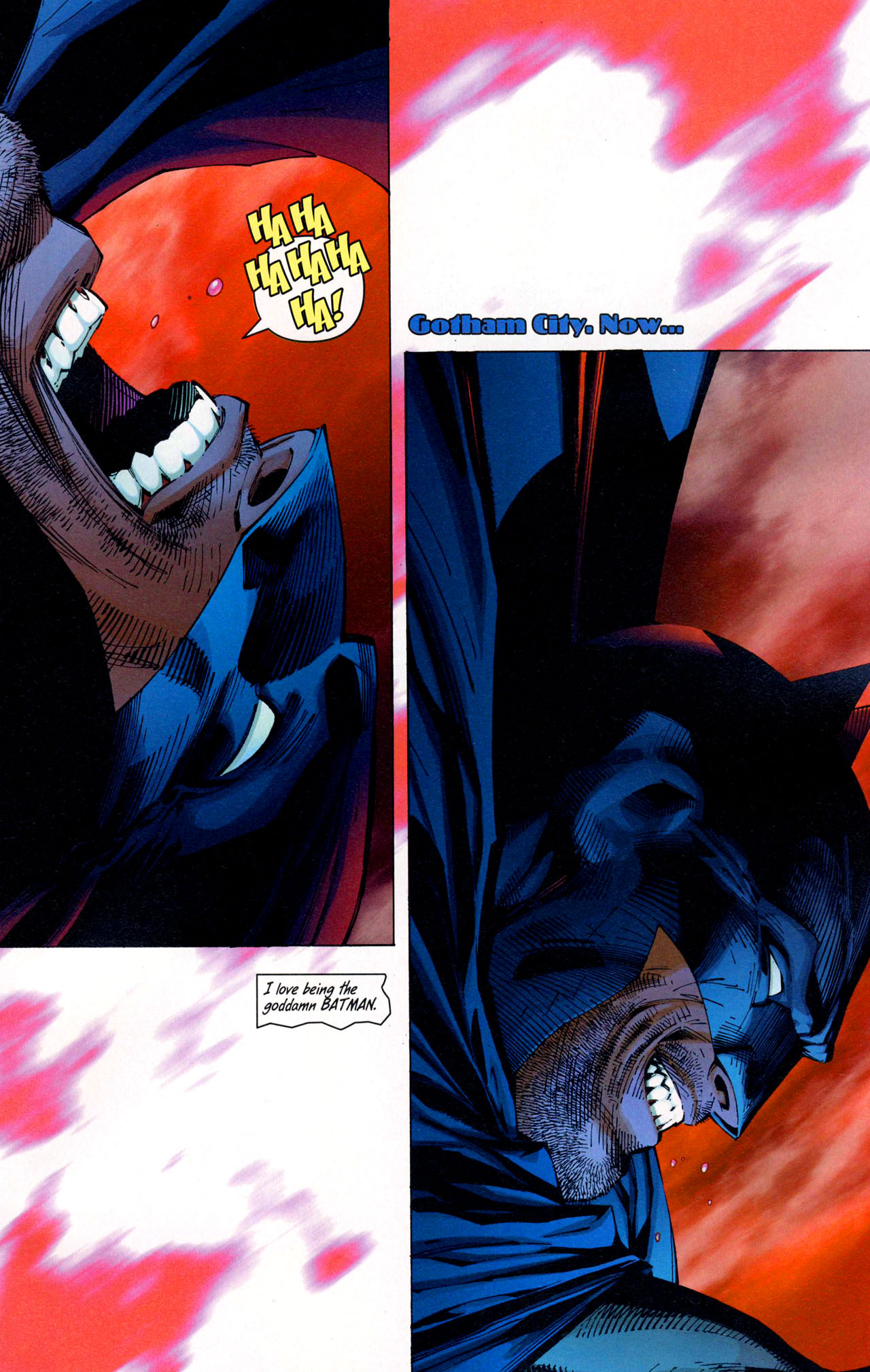
Now some people claim that this incarnation of Batman is meant to be a self-parody, or a satire - but when you compare it to Frank Miller's creative output of the last couple of years, it's really similar. Which could mean that Frank Miller has been doing nothing but parodying himself in films like The Spirit, and comics like the forthcoming Holy Terror (which was originally intended to feature Batman fighting Al Qaeda) ... or as other people believe, Frank Miller has gone the way of George Lucas.
Either he's become deeply greedy, and is making things just because he knows people will buy them, and he's simply no longer invested or interested in telling compelling, well-crafted stories ... or, he's actually gone insane. This debate has been going on for some time in the fan community, and I don't expect it will stop any time soon.
I'm not really sure where I stand. But I do think it's a shame that one of my favourite comic creators, who really made me appreciate the craftsmanship and passion and pure creative energy that goes into creating a comic, who made me look at my favourite fictional character in a whole new light ... I think it's a shame that now a great many people think he's a hack, and that I, personally, haven't been able to enjoy anything he's written since Sin City.
Obviously, all this is just my opinionated ruminating. I'm sure many of you out there disagree. So please, feel free to share in the comments section!

This is why I love you.
ReplyDeleteBut what's wrong with Irish sex kittens?
Relevant:
ReplyDeletehttp://io9.com/5845828/frank-millers-holy-terror-isnt-just-a-bad-comic--its-a-bad-propaganda-comic