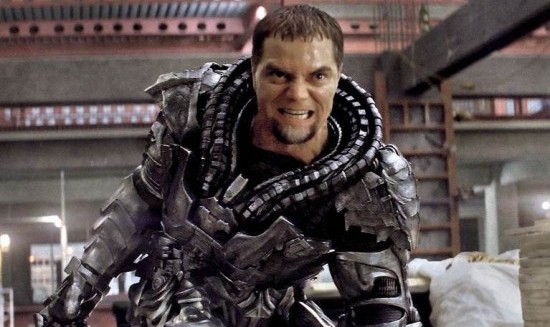
I so want DC/Warner's TV outings to be good. Nothing would make me happier. But if the leaked pilots for Constantine and The Flash are any indication, they are going to keep fumbling the ball just like their live action film department.
First up, Constantine.
Of all the new DC TV shows they have coming out, I was most excited for this one. John Constantine, created by Alan Moore and nurtured by some of comics' greatest talents (Garth Ennis, Jamie Delano, Brian Azzarello, Warren Ellis) is one of DC's underused treasures. His series, Hellblazer, was the longest running Vertigo comic, and among its most consistently daring. In the comics, Constantine is a professional "bad-luck" magician who relies on deceit, cleverness, and being a bit of a bastard to ply his trade in an underworld rife with magicians, demons, and pure human evil.
He's clever, but he has been outplayed. He's had moments of absurd daring and contemptible cowardice. He's faced his problems head on with a smile, a wink, and a lit cigarette (always Silk Cut) and he's abandoned his responsibilities and left his friends (and the world) to suffer. He's been through Hell and come out the other side. In other words, he's one of DC's most human characters.
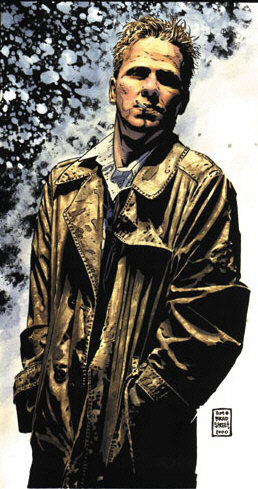
The parade of great creators who've written him have used him to touch on the social climate of the times, from Ennis' portrayal of Thatcherite-Britain and the Irish Troubles to Azzarello's withering portrait of the American prison system to Ellis' examination of the fears of the early 21st century, Constantine's a cracked mirror through which we view our own fears, our own demons.
Frankly, the character and the world he inhabits are ripe for exploration in the context of television. There's already been one utterly wretched adaptation of the character (2005's Constantine film, starring the woefully miscast Keanu Reeves). This was a chance to rectify that mistake.
It comes as no surprise (though I wish it did) that DC would fuck it all up.
A brief list of some of the problems in the pilot.
1) The actor playing Constantine more or less looks the part, but he's using his native Welsh accent, not John's accent, which should be Cockney. That's as vital to his character as anything. Constantine's a working-class rabble rouser who thumbs his nose at the establishment - any establishment. While I'm well aware that the Welsh have a history of social resistance, it just doesn't carry the same cultural cachet as Constantine's original sound. It just felt weird hearing Edward Kenway's voice when I expected to hear John.
2) Once AGAIN, it's set in AMERICA. Jesus. London is pretty much the most important character in Hellblazer besides John himself. It's an ancient city full of history and secrets. The setting of the show [Anyville USA] was so bland as to be completely inconsequential. At least Keanu's LA had some personality.
3) ... In fact, that's something i think counts as a major strike against this show. It just feels bland. Hackneyed. Seen this, been there, done that. Could be any of the 3rd-string demon hunter shows of the last 15 years.
4) You know what else? They don't really seem to get Constantine's character. He's not on a big quest for redemption. He never has been. The real tragedy of Constantine is that, at the end of the day, he can't help himself from tinkering, and his loved ones always pay the price. He feels guilty, but not guilty enough to stop. Ever. He's a magic junkie, a thrill junkie - THAT's his tragedy. Which is WAY more interesting than the standard "atoning for past mistakes arc."
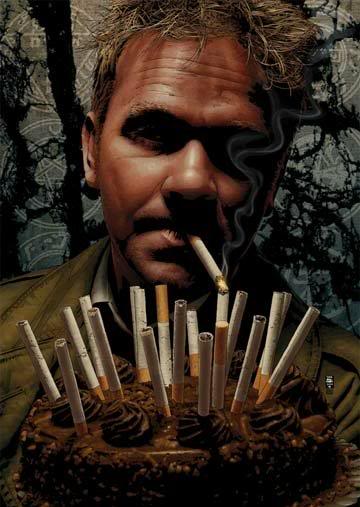
More than that, the Constantine in this show solves the problems through boegedy-boogedy magic rather than using his cunning and quick thinking. We don't even see him smoking for God's sake, which is not only an important aspect of his character, but actually becomes a vital plot point in the comics. Instead of just censoring the fact that you main character smokes, why not actually show the consequences of smoking by showing John Constantine suffering from lung cancer.
5) And the "supporting cast" is pretty laughable. I mean, Harold Perinneau is doing his best, but ... come on. The girl/mcguffin is as interesting as cardboard, and none of Constantine's old friends or acquaintances are as lively as the many supporting cast members introduced in the comics. And making Chazz, his cabbie/best mate, into a supernatural character pretty much defeats the POINT of Chazz, which is that he's just a normal bloke, just like John, only even more so because Chaz has no connection to the world of magic.
6) And all the DC references come off as forced and obvious. I mean, it's clear they're trying to do what Marvel has being doing so successfully, but they don't get WHY it's successful. The Marvel nods have by and large been understated. The Infinity Gauntlet in Thor doesn't draw attention to itself, nor does Cap's shield in the first Iron Man or the Doctor Strange nod in The Winter Soldier. If you don't know what those objects or references are, it doesn't interrupt the flow of the story.
But when she held up that Doctor Fate mask it was like: look at me! Look! A DC comics character you might see one day! Likewise Ivy University.
7) That whole basement set (which is too elaborate not to return as their base of operations) is all wrong. John's at his best as a regular bloke who hangs out down the pub and has a scummy little London flat. He wouldn't surround himself with all the magic bollocks.
8) None of the demon/ghost/magic stuff struck me as particularly frightening or inventive. I've seen the same things done better elsewhere.
Long story short, this show strips Constantine of his charm, his supporting cast, and his unique take on the urban horror genre. What is left is a bland, unappetizing "demon-hunter" show we've seen a dozen times before, but even more disappointing because we know what might have been.
Next up, I'll talk about The Flash pilot. It's better, but not by much.
Sunday, 17 August 2014
Monday, 16 June 2014
The Pretentious Douchebag, or, How I Was Bullied At the Age of 25
So, a couple of days ago I met a bully.
The afternoon started off well. A pretty girl was chatting
me up on the King streetcar. She asked about the book I was reading (Kraken, by
China Miéville.) It was a pleasant diversion, and a pick-me-up – not every day
a perfect stranger engages you in small talk. Certainly not in Toronto. I had
to transfer to a different streetcar, so I said my goodbyes and arrived at the
College streetcar platform with a spring in my step, and cracked open my book
again.
“What’re you reading there?” This, from a skinny, scruffy
blond fellow. I assume by his dress, his youth, and our location a student at
Univerisity of Toronto.
I held the book up and told him the title.
“What’s it about?”
I told him the story thus far – a giant squid disappears
from the Darwin Centre in London, which sets of an investigation into
apocalyptic squid-cults and mysterious, murderous magicians.
“Oh, so what, is it magical realism?” the stranger asked me
doubtfully.
“No,” I replied. “More like straight-up urban fantasy.”
“Ah.” Understanding lit up his features, along with the
first hint of a condescending smile. “So it’s lowbrow.”
Confusion. Hurt. Followed by defensiveness. Tamped down by
rationality. I was going to give him the benefit of the doubt. “What do you
mean by that?” I asked politely. I was unconsciously holding the book to my
chest.
“You know. Lowbrow. Nothing wrong with that. I like a little
lowbrow now and then.” Said with the same tone as someone who likes a little
dogshit in their icecream.
“Well, I don’t – why do you say it’s lowbrow?”
“Why don’t you read something better, more highbrow? Like
Gabriel Garcia Marquez?” he countered.
“Marquez isn’t really my thing.” I answered. Anger, a kettle
on the boil in my guts. “Why do you think this is lowbrow?”
“Hey,” he said by way of kind-of apology, “Lowbrow’s not a
bad thing.”
“It kind of –“
“When was it written?” he interrupted. Smug. So fucking
smug.
I had no idea what he was getting at, except that this was
another joke being had at my expense.“Mid two-thousands.”
“Ah, see that’s how I know it’s bad. Nothing good’s been
written in the magic realism genre in seventy years.”
I can’t recall exactly what I said, to be honest, only that
I know it was angry and insulting and it caught the fucker off guard. He didn’t
seem to get why I was so upset. Or at least that was how he acted. Then the
smug, self-satisfied smirk returned. He pointed to the cover of my book, which
I was now clutching protectively to my chest.
“It says international bestseller on it? That’s how you know
it’s lowbrow.” All triumph.
“So if people like something, if something’s popular, it
must not be any good?” I asked, bewilderment battling it out with the simmering
anger.
“Yeah, pretty much,” he shrugged.
This is when I snapped. “Why did you even start a
conversation with me?” I asked. “You’ve never even met me! Do you just like to
pick fights with people? Did you just want to pick a fight with me?”
“Yeah,” he shrugged. “I was bored.” I couldn’t believe it. I
was actually struck speechless. I was so angry, so hurt, so humiliated
(somehow) that I turned on my heel and walked the rest of the way home. No way
was I going to spend a whole streetcar ride with this asshole.
On the long walk home, I thought of all the cutting, clever,
savage, witty and incisive and cruel things I should have said. All the while
my fury and my shame and my hurt roiling within me. My good mood from the
pretty girl? Vanished. My whole evening ruined. And I realized on that walk,
that this is what it felt like to be bullied, when I was in middle school. To
be made fun of, to have something I liked put down, by some tool who didn’t
even know me, for no discernable reason at all.
So here’s what I wanted to say to that condescending elitist
hipster douchebag: FUCK YOU.
First up: Lowbrow and highbrow are bullshit terms that you
and elitist douchebag pricks like you use to ghettoize genre fiction, to
separate what you deem worthy from everything else so you can feel good about
being a gatekeeper of ‘worthy literature.’ You might be surprised to learn that
I have read Marquez, and simply found him not to be my cup of tea. I would be
shocked to learn that you had read anything by Gaiman, or Heinlein, or Miéville
(one of the most critically lauded authors of his generation). It would be
beneath you, right?
I’m here to tell you. There are good books, and there are
bad books, but neither is defined by a genre. They are defined by the skill and
talent and craft and creativity that went into creating them. A lot of genre
fiction is bad. And so is a lot of literary fiction. So fuck you and your
elitism right in your elitist skinny-jean-wearing cornhole.
Second: Fuck you for being a bully. Fuck you for taking
malicious pleasure in making someone else feel bad for liking something. Fuck you for thinking you’re better than me
because you don’t read the same things I’ve read. Fuck you for taking me out of
a righteous good mood and putting me in a shitty mood for much of the rest of
my day. You’re an asshole.
I was in a shitty mood, and I stayed that way for a few
hours. As luck would have it, that evening I was hanging out with some friends,
who with their good humour and kind words helped me see the funny side. Now I
can look back on this complete asshole and laugh, because he’s practically a
cartoon of himself – a smug little ponce in skinny jeans who never learned how
to shave, who gets his jollies putting down other people for liking fantasy when they should be reading magic realism. I can’t imagine a more
ridiculous caricature of someone who is both a too-cool-for-school hipster and
a complete fucking dork.
But that day reminded me that just because school is over
doesn’t mean bullying is over. There’s always going to be people who try to
make you feel bad for who you are, whether it’s for being gay, or black, or a
Conservative, or a vegan, or a dude who likes his entertainment with a side of
murder and explosions and werewolves and tits.
The thing we have to remember about those people is that
they have no power over us. They lash out because they see that what we are or
what we love makes us happy – and because they are unhappy, they try to bring
us down to their level. What we have to remember about the bully is that they
are weak, and pathetic, and as my friends helped me realize about this guy –
they end up being nothing. This guy made me feel shitty for a few hours, and
that sucked. But I’ll be laughing at his ridiculous, pompous douchebaggery for
a lot longer than that.
Tuesday, 4 March 2014
On the Legitimacy of Genre
One of the things that has always bothered me as a reader, a writer, and a consumer of media is the way the artistic establishment treats "genre" fiction as opposed to "realistic" or "literary" fiction.
Typically, people argue that serious literary fiction, like that of Joyce, or Atwood, or Ondaatje or Hemingway, exposes the truth of the human condition and makes us question the way the world works, whereas genre fiction is nothing more than cheap escapism. I don't think it's a stretch to say that any fiction that falls within a clear-cut genre (sci-fi, fantasy, horror, romance, western, mystery, thriller, action-adventure) is frequently discounted as being "serious", or having real artistic merit.
To that, I say: bollocks.
Genre fiction has just as much to say about the world we live in and the human condition as genre fiction. Sure, in high school we get the token examples of 1984 or Fahrenheit 451 or The Handmaid's Tale, held up as literary works of dystopia. And those are all good books. But what gets my goat is that they're always taught in this sort of apologetic "Well, they're really very good books, they just happen to be science fiction, sorry about that."
This completely discounts all the brilliant, incisive work of hundreds of authors for hundreds of years. What about Octavia Butler, whose Bloodchild explores the intersection of slavery, sexual abuse and co-dependancy - in a story about parasitic aliens who have conquered the human race? What about Stephen King's The Shining, a beautiful character portrait of a desperate man struggling with alcoholism and his own abusive nature - all the while being tormented by the malevolent spirits of the Overlook Hotel? What about Blade Runner, which examines the very crux of the question "What does it mean to be human?"
The literary and educational establishment totally dismiss genre fiction as having literary merit, when it so obviously does. Personally, I think it's because (God help us) genre fiction also has the desire to be entertaining. Heaven forfend that an audience be entertained.
Hell, you know who wrote entertaining, supposedly "low-brow" genre fiction? William Motherfucking Shakespeare. Macbeth features witches, ghosts, prophecies and curses, and in some productions the Devil himself. It's also a brilliant depiction of ambition, greed, and a disintegrating marriage. That's just the most obvious example, but every Shakespeare play falls into one of the three predominant genres of his era (Comedy, Tragedy, and History) and every one of them features a) violence, b) sex (or at the least, sexual innuendo) and c) clowning or slapstick humour, in order to keep the punters in their seats. You know what else every Shakespeare play features? Meaningful insight into the human condition and the life and times of the author. Shakespeare has lots of powerful things to say, but at heart, he's an entertainer.
Now, that's not to say that there isn't bad fiction out there - meaningless shallow trash, badly written and poorly conceived. Of course there is. Bookshelves are stuffed with it, movie theatres and bargain DVD bins are packed with 'em. But that bad fiction is not limited exclusively to genre fiction. 90% of all art is crap. There are plenty of examples of empty, navel-gazing aimless literary fiction, more interested in flowery, meticulously crafted prose or artful swoops of the camera than, you know - telling a goddamn story.
That's what it boils down to people. Telling a story that matters, that grabs your audience and doesn't let go. Doesn't matter if it's about spaceships and aliens or the quiet disintegration of a marriage. What matters is that we are made to care.
Typically, people argue that serious literary fiction, like that of Joyce, or Atwood, or Ondaatje or Hemingway, exposes the truth of the human condition and makes us question the way the world works, whereas genre fiction is nothing more than cheap escapism. I don't think it's a stretch to say that any fiction that falls within a clear-cut genre (sci-fi, fantasy, horror, romance, western, mystery, thriller, action-adventure) is frequently discounted as being "serious", or having real artistic merit.
To that, I say: bollocks.
Genre fiction has just as much to say about the world we live in and the human condition as genre fiction. Sure, in high school we get the token examples of 1984 or Fahrenheit 451 or The Handmaid's Tale, held up as literary works of dystopia. And those are all good books. But what gets my goat is that they're always taught in this sort of apologetic "Well, they're really very good books, they just happen to be science fiction, sorry about that."
This completely discounts all the brilliant, incisive work of hundreds of authors for hundreds of years. What about Octavia Butler, whose Bloodchild explores the intersection of slavery, sexual abuse and co-dependancy - in a story about parasitic aliens who have conquered the human race? What about Stephen King's The Shining, a beautiful character portrait of a desperate man struggling with alcoholism and his own abusive nature - all the while being tormented by the malevolent spirits of the Overlook Hotel? What about Blade Runner, which examines the very crux of the question "What does it mean to be human?"
The literary and educational establishment totally dismiss genre fiction as having literary merit, when it so obviously does. Personally, I think it's because (God help us) genre fiction also has the desire to be entertaining. Heaven forfend that an audience be entertained.
Hell, you know who wrote entertaining, supposedly "low-brow" genre fiction? William Motherfucking Shakespeare. Macbeth features witches, ghosts, prophecies and curses, and in some productions the Devil himself. It's also a brilliant depiction of ambition, greed, and a disintegrating marriage. That's just the most obvious example, but every Shakespeare play falls into one of the three predominant genres of his era (Comedy, Tragedy, and History) and every one of them features a) violence, b) sex (or at the least, sexual innuendo) and c) clowning or slapstick humour, in order to keep the punters in their seats. You know what else every Shakespeare play features? Meaningful insight into the human condition and the life and times of the author. Shakespeare has lots of powerful things to say, but at heart, he's an entertainer.
Now, that's not to say that there isn't bad fiction out there - meaningless shallow trash, badly written and poorly conceived. Of course there is. Bookshelves are stuffed with it, movie theatres and bargain DVD bins are packed with 'em. But that bad fiction is not limited exclusively to genre fiction. 90% of all art is crap. There are plenty of examples of empty, navel-gazing aimless literary fiction, more interested in flowery, meticulously crafted prose or artful swoops of the camera than, you know - telling a goddamn story.
That's what it boils down to people. Telling a story that matters, that grabs your audience and doesn't let go. Doesn't matter if it's about spaceships and aliens or the quiet disintegration of a marriage. What matters is that we are made to care.
Labels:
critical thinking,
rambling
Location:
Toronto, ON, Canada
Monday, 17 February 2014
The Problem with Blockbusters Part Four
Problem #4: The film's set pieces aren't that exciting.
Summer blockbusters have to have exciting set-pieces, action scenes where people throw punches, cars get chased, and things get blowed up real good. You might say they are the raison-d'etre of the entire genre. The spectacle of these movies is what puts bums on seats. But in a good movie, the spectacle isn't empty. It serves a purpose, both in terms of the drama, and in terms of the structure of a film.
One of the most important rules of telling a gripping story is that you have to be constantly raising the stakes. With every twist and turn of the plot, things have to become more and more desperate for our protagonists. In terms of action set-pieces, this means that every set piece has to be more impressive, exciting and meaningful than those that came before.
There's a very good reason for this rule, a very practical reason: if you put your most exciting set piece in the middle of the movie, or near the beginning, you will fail to impress the audience with every subsequent set piece, and they will feel let down. In other words, you have blown your wad too early, leaving the audience in a state of disappointment, and leaving yourself in a state of shame. Y'know, just like in real life.
Sounds simple, right? Two rules to follow:
1) Make your set-pieces exciting and relevant to the characters and the story.
2) Make sure that each set piece is more exciting, impressive and relevant than the one that came before.
Given the talent and budget involved in making a film like this, it's surprising to me how often these rules are ignored or overlooked.
Let's look at the blockbusters from this past summer, and see how they measure up:
Frankly, I can't even remember most of the action set pieces from this movie. I feel like this has to do with my complete lack of investment in Thor's character. (See this post.) But as I recall, at least they get more epic and impressive (in theory) as the film goes on. The climactic dimension-hopping slugfest with Malekith the Entirely Unmemorable would have been a lot more impressive if I cared about either character. Talk about working on the fundamentals, people.
Okay, so things are looking pretty grim. But there were two movies this summer who really got structure and stake-raising in an intelligent way.
Summer blockbusters have to have exciting set-pieces, action scenes where people throw punches, cars get chased, and things get blowed up real good. You might say they are the raison-d'etre of the entire genre. The spectacle of these movies is what puts bums on seats. But in a good movie, the spectacle isn't empty. It serves a purpose, both in terms of the drama, and in terms of the structure of a film.
One of the most important rules of telling a gripping story is that you have to be constantly raising the stakes. With every twist and turn of the plot, things have to become more and more desperate for our protagonists. In terms of action set-pieces, this means that every set piece has to be more impressive, exciting and meaningful than those that came before.
There's a very good reason for this rule, a very practical reason: if you put your most exciting set piece in the middle of the movie, or near the beginning, you will fail to impress the audience with every subsequent set piece, and they will feel let down. In other words, you have blown your wad too early, leaving the audience in a state of disappointment, and leaving yourself in a state of shame. Y'know, just like in real life.
Sounds simple, right? Two rules to follow:
1) Make your set-pieces exciting and relevant to the characters and the story.
2) Make sure that each set piece is more exciting, impressive and relevant than the one that came before.
Given the talent and budget involved in making a film like this, it's surprising to me how often these rules are ignored or overlooked.
Let's look at the blockbusters from this past summer, and see how they measure up:
Thor: The Dark World
Frankly, I can't even remember most of the action set pieces from this movie. I feel like this has to do with my complete lack of investment in Thor's character. (See this post.) But as I recall, at least they get more epic and impressive (in theory) as the film goes on. The climactic dimension-hopping slugfest with Malekith the Entirely Unmemorable would have been a lot more impressive if I cared about either character. Talk about working on the fundamentals, people.
The Wolverine
Oy, where to begin with the Wolverine. Okay, so there's one cool fight in the movie, the fight atop the high-speed bullet train. It's exciting, it's a challenge for the character. It made me gasp with excitement and awe a few times. So they got that going for them. But that's one scene, and it's not very long. Whereas every other action scene in the movie is pretty underwhelming. The fight against the yakuza goons at the funeral is pretty boring, as is the sword/claw fight with Mariko's father.
But what really ticks me off in this movie is the climax. The whole film, they've been building to: Wolverine fights ninjas. They tease us with the ninjas storming the Yashida compound, they show Wolverine walking up to a Yashida village … and then they just shoot him with arrows and drag him inside the complex. The end. Wolverine doesn't fight a single ninja. Not one. I couldn't believe my eyes. And then he fights a big boring robot that they have instead of the actual Silver Samurai. Again, couldn't believe it. Talk about dropping the ball.
Star Trek Into Darkness
Star Trek Into Darkness is something of an improvement. The fights, chases and so-forth build nicely, both in terms of stakes and in terms of visceral excitement - up to a point. For me, the high point of was Khan and Kirk's flight through the debris field to the enemy spaceship. The tension is raised because of Khan's questionable relationship to the protagonists - and then we find that Scotty is in trouble with one of the space-ship's crew - and then Kirk develops a crack in his faceplate and his navigation goes offline … it's a tense, exciting sequence.
Where the film fumbles the ball is in the visually underwhelming climax - the chasedown of Khan feels like something I could see in any number of pedestrian action films - not something that belongs in a star trek films. And frankly, just beating Khan to a pulp isn't a very satisfying end to the supposed big bad of the film.
Man of Steel
Man of Steel features the simple problem of us not caring. The last 45 minutes of the film are a non-stop orgy of super-powered violence, and I will give credit where credit is due - it's a visually impressive series of super-punches and buildings getting knocked down. Where the film fails utterly is in giving us any reason to care, and in loading all of this impressive destruction at the end of the film. Furthermore, the fights become dull and repetitive: Superman punches someone, someone punches him back, but no real consequences are given and no stakes are raised. Nowhere (except for the film's horrendously out of character climax) are any civilians put in direct jeopardy, nor are there any twists or dramatic revelations that change the context of the fight.
And it is that horrendous climax that seals Man of Steel's fate. It attempts to raise the stakes by having Zod threaten the civilians in the train station, and tries to present us with a moral quandary - will Superman be forced to kill him to save the lives of those civilians? However, this is a false quandary. Even sitting in the movie theatre, I could think of several ways for Superman to escape that scenario (including flying away, turning Zod's head, putting his hand over Zod's eyes) none of which he attempts. Instead, David Goyer and Zack Snyder commit the grievous sin of going against the fundamental nature of a character in order to falsely elicit a "dark, gritty, emotional ending." They think this will make the action, and the climax, more powerful and meaningful. Instead, they accomplish the opposite.
Okay, so things are looking pretty grim. But there were two movies this summer who really got structure and stake-raising in an intelligent way.
Pacific Rim
Guillermo del Toro's delightful monster mash isn't going to win any Oscars. But it understands intuitively how to raise the stakes. Every fight between Kaiju and Jaeger has something at stake - from the life of our hero's brother in the first fight, to the fate of our entire planet in the last. (See how things suddenly got a lot more epic over the two hour course of the film?) And even though the fights are all between robots and monsters, they never get stale. The locations change. The weapons change. The monsters change. The final fight is at the bottom of the ocean, for heaven's sake!
But this summer's clear winner is …
Iron Man 3
In Iron Man 3, Shane Black masterfully raises the stakes again and again. Every set piece is different from the one that came before, and in each the tension rises and the consequences become more dire. And then, just when you think things can't get any more dire for our heroes - they do! New wrinkles abound at every turn, forcing Tony to think on his feet and threatening things he holds dear as a character.
And of course, in terms of sheer excitement, it simply builds and builds wonderfully. We're given just a taste of Tony in action in the suit before it's taken away from him - and then he spends much of the rest of the film surviving by his wits and ingenuity. Of course, when the Iron Man suit is returned to him, he immediately goes into action in a truly thrilling mid-air rescue on Air Force One. It was the big action set piece in all the trailers - and it's not even the end of movie. There's another high-stakes battle in which all the stops of special-effects wizardry and character motivation are pulled out. And amid all the flying metal suits and red-hot super-soldiers, there isn't an unclear or confusing moment of action, or one instance of shaky-cam. Michael Bay should be taking notes.
When you're making an action movie, you can't just slap some CGI flimflammery together and expect it to make your film exciting and memorable. For that, you have to pay attention to structure, and to storytelling.
PS: While I haven't been including it as a blockbuster, I want to give a shout out to Edgar Wright's World's End, which despite being mostly a comedy, has some of the most visceral and exciting fight scenes of any film this year. If this is the quality of action we can expect in Ant Man, we are in for a treat.
Sunday, 26 January 2014
The Problem With Blockbusters, Part 3
Problem #3: Where's the
villainy?
Every good blockbuster needs a good villain. No,
scratch that - every good blockbuster has a great villain. A
great villain isn't just a faceless nobody. A great villain has personality. A
great villain is (often, but not always) a dark mirror of the protagonist. A
great villain can take the hero's quips and toss them right back,
and terrorize the audience, even as we can't wait to see what they'll do
next.
A great villain makes a
movie memorable, and they help define the protagonist by virtue of their
villainy. John McClane has Hans Gruber. Batman has the Joker (in two
excellent and wildly different incarnations). Sarah Conner has the Terminator.
Neo has Agent Smith. Luke Skywalker has Darth Vader (who is pretty much the
template for an amazing villain).
But lately, big
blockbusters have been sorely lacking in the villain department.
Sometimes it's because they
have no personality, nothing to make them unique. They're generic to the point
of being caricatures or clichés.
Sometimes it's because
their villainous motives are muddy, and their characters are ill-defined.
Sometimes it's because
they're not actually good at being bad.
Sometimes it's because
they're just. Not. Scary.
Take Khan in Star Trek
Into Darkness. He's the almost-but-not-quite exception to this list.
The film-makers tried really hard to make Khan cool and scary and complex, and
Bendedict Cumberbatch delivered the charm and menace with his typical aplomb.
But the Khan of J.J. Abrams' movie was nowhere near as compelling as Ricardo
Montalban's iconic, scenery-chewing performance.
is not as
scary as
Khan suffers from the
problem of being an ill-defined character. At the beginning of the film, we
hate him - he blew up a bunch of people! He killed Pike! That makes him bad!
Then we find out that he had a pretty good justification (Starfleet held his
crew hostage and kept him prisoner so they could build futuristic WMDs) for
killing all those people, and as an audience, we're on his side again. Then,
for no discernible reason, and with no discernible plan, he turns evil again
just so the film can have a climax.
This goes against his
characterization as a tactical genius, and furthermore, it's a difficult pill
to swallow because at no point in the film does Khan do something completely
evil. He displays no taste for sadism or callous brutality. All the people he
kills or attacks, he has good reason to do. The only reason we have to believe
that he's actually a bad guy is that Old Spock tells us he is. Which is
breaking the #1 most basic rule of storytelling - SHOW, DON'T TELL.
By contrast, Montalban's
Khan:
a) Has a clear motive that
drives his character (Revenge against Kirk.)
b) He has a unique
characterization (his love of Moby Dick) including tragic flaws
(obsession, arrogance)
c) is, even with his
understandable motivations, evil, and the film shows us. He takes
sadistic pleasure in forcing the awful mind-worms on Chekov, and rather than
kill his nemesis, as he famously tells us:
"I've done far worse than kill you,
Admiral. I've hurt you. And I wish to go on hurting you. I shall leave you as
you left me, as you left her; marooned for all eternity in the center of a dead
planet... buried alive! Buried alive…!"
Even so, Star Trek Into
Darkness has one of the better villains of the summer. Here's a brief
rundown of the other offenders.
Man of Steel's General Zod: A thinly characterized one-dimensional
space Hitler. He has no memorable personality beyond screaming and bugging his
eyes. He has only the vaguest and most nebulously defined goals of rebuilding
Krypton and achieving genetic purity and getting revenge on
Jor-El by beating up his son, all of which serves to make him so boring that I
don't care who he kills, or how many buildings he knocks down.
Elysium had Jodie Foster playing Rich White Jerk #1. The
only thing that made her character at all remarkable is that she was a woman.
If you replaced her character with a man, the film wouldn't change at all. But
it wouldn't really change if you replaced it with a piece of wood either. The
only concession to giving her a unique quality is her frankly ridiculous
accent. Sharlto Copely brings the crazy, but despite how cool he looks and
sounds - he's not a very effective villain.
The Wolverine had way too complex a plot, including
a multitude of ill-defined villains. Viper was the clichéd femme fatale,
Yuriko's father (whose name I can't recall, which is already a bad sign) is the
clichéd evil father, and the film's ultimate villain is the clichéd switcharoo,
where the character you thought was good turns out to be bad all along. For no
real reason except the film wanted a plot twist. And side-note - they
completely mishandled a really badass villain, the Silver Samurai.
Once again, the summer's
bright spot turns out to be Iron Man 3.
MASSIVE SPOILERS TO FOLLOW
…
…
…
Okay, you were
warned.
So, part of the charm
of Iron Man 3 is the fact that writer/director Shane Black gave us
a throwback to the action movie heyday of the 80s and 90s. And one of the
things even bad action movies of that time did well was memorable, over the top
villains. Iron Man 3 does the same.
First of all, the Mandarin.
The Mandarin is built up as a deadly threat, to the point where I was really,
really anticipating his inevitable showdown with Iron Man. Of course, part of
the genius of the film is that we only get glimpses of The Mandarin, just like
the shark in Jaws. Black gives us lines like "No talking and no eye
contact unless you want to get shot in the face" to sell us on the idea
that this guy is a dangerous psycho, and we see him casually presiding over
atrocities and making cold-blooded speeches about murdering people. The
Mandarin is established as having a clear goal (the overthrow of the United
States and the murder of the U.S. President), having a personality (kind to
children, speaks in parables, doesn't like being looked at, Chinese
iconography), and being irredeemably evil (kills multiple innocents to
prove a point). All of which makes him memorable and scary. So Iron Man 3 has
got itself a wonderful villain.
Except of course, Ben
Kingsley's Mandarin is a fake. That's right. Iron Man 3 satisfies all
the criteria for a great screen villain - and he's not even the real bad guy.
The real bad guy is Guy Pearce's character, Aldritch Killian, and
guess what? He also satisfies all the criteria of villainy. His
goals are the same as the fake-Mandarin's, plus getting Pepper Potts as his
trophy and one-upping or killing Tony. He has a personality - even an honest to
goodness character arc. He goes from being bullied and ignored by Tony Stark to
reinventing himself as a ruthless amoral arms dealer. And he's funny!
Some of his quips are just as good as Tony's. (I especially love his
exasperated "Pepper, please." while he's holding her against a wall
by her throat, she's struggling to get free, and he's just trying to carry on a
conversation.) Not only is he funny, but he is evil and we see him being
evil. He casually murders Rebecca Hall's character when she starts mouthing
off, he taunts Tony when they both believe Pepper to be dead, and he poses a
serious threat to Tony in a fight. Furthermore, he's a dark reflection of Tony
Stark without being just another guy in a metal suit. He's a great, memorable,
menacing villain.
Hell, even the "sub-bosses" of the movie, the other Extremis soldiers, are memorable villains, with personalities that distinguish them from the generic cannon fodder baddies. They aren't just faceless props in a set piece.
Regrettably, Iron Man 3 is the exception, rather than the rule. It should be obvious, but it's not (apparently) - having a great villain is key to having a successful blockbuster.
Subscribe to:
Comments (Atom)