Problem #3: Where's the
villainy?
Every good blockbuster needs a good villain. No,
scratch that - every good blockbuster has a great villain. A
great villain isn't just a faceless nobody. A great villain has personality. A
great villain is (often, but not always) a dark mirror of the protagonist. A
great villain can take the hero's quips and toss them right back,
and terrorize the audience, even as we can't wait to see what they'll do
next.
A great villain makes a
movie memorable, and they help define the protagonist by virtue of their
villainy. John McClane has Hans Gruber. Batman has the Joker (in two
excellent and wildly different incarnations). Sarah Conner has the Terminator.
Neo has Agent Smith. Luke Skywalker has Darth Vader (who is pretty much the
template for an amazing villain).
But lately, big
blockbusters have been sorely lacking in the villain department.
Sometimes it's because they
have no personality, nothing to make them unique. They're generic to the point
of being caricatures or clichés.
Sometimes it's because
their villainous motives are muddy, and their characters are ill-defined.
Sometimes it's because
they're not actually good at being bad.
Sometimes it's because
they're just. Not. Scary.
Take Khan in Star Trek
Into Darkness. He's the almost-but-not-quite exception to this list.
The film-makers tried really hard to make Khan cool and scary and complex, and
Bendedict Cumberbatch delivered the charm and menace with his typical aplomb.
But the Khan of J.J. Abrams' movie was nowhere near as compelling as Ricardo
Montalban's iconic, scenery-chewing performance.

is not as
scary as

Khan suffers from the
problem of being an ill-defined character. At the beginning of the film, we
hate him - he blew up a bunch of people! He killed Pike! That makes him bad!
Then we find out that he had a pretty good justification (Starfleet held his
crew hostage and kept him prisoner so they could build futuristic WMDs) for
killing all those people, and as an audience, we're on his side again. Then,
for no discernible reason, and with no discernible plan, he turns evil again
just so the film can have a climax.
This goes against his
characterization as a tactical genius, and furthermore, it's a difficult pill
to swallow because at no point in the film does Khan do something completely
evil. He displays no taste for sadism or callous brutality. All the people he
kills or attacks, he has good reason to do. The only reason we have to believe
that he's actually a bad guy is that Old Spock tells us he is. Which is
breaking the #1 most basic rule of storytelling - SHOW, DON'T TELL.
By contrast, Montalban's
Khan:
a) Has a clear motive that
drives his character (Revenge against Kirk.)
b) He has a unique
characterization (his love of Moby Dick) including tragic flaws
(obsession, arrogance)
c) is, even with his
understandable motivations, evil, and the film shows us. He takes
sadistic pleasure in forcing the awful mind-worms on Chekov, and rather than
kill his nemesis, as he famously tells us:
"I've done far worse than kill you,
Admiral. I've hurt you. And I wish to go on hurting you. I shall leave you as
you left me, as you left her; marooned for all eternity in the center of a dead
planet... buried alive! Buried alive…!"
Even so, Star Trek Into
Darkness has one of the better villains of the summer. Here's a brief
rundown of the other offenders.
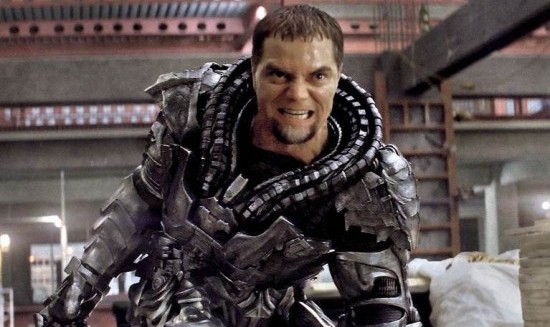
Man of Steel's General Zod: A thinly characterized one-dimensional
space Hitler. He has no memorable personality beyond screaming and bugging his
eyes. He has only the vaguest and most nebulously defined goals of rebuilding
Krypton and achieving genetic purity and getting revenge on
Jor-El by beating up his son, all of which serves to make him so boring that I
don't care who he kills, or how many buildings he knocks down.

Elysium had Jodie Foster playing Rich White Jerk #1. The
only thing that made her character at all remarkable is that she was a woman.
If you replaced her character with a man, the film wouldn't change at all. But
it wouldn't really change if you replaced it with a piece of wood either. The
only concession to giving her a unique quality is her frankly ridiculous
accent. Sharlto Copely brings the crazy, but despite how cool he looks and
sounds - he's not a very effective villain.

The Wolverine had way too complex a plot, including
a multitude of ill-defined villains. Viper was the clichéd femme fatale,
Yuriko's father (whose name I can't recall, which is already a bad sign) is the
clichéd evil father, and the film's ultimate villain is the clichéd switcharoo,
where the character you thought was good turns out to be bad all along. For no
real reason except the film wanted a plot twist. And side-note - they
completely mishandled a really badass villain, the Silver Samurai.
Once again, the summer's
bright spot turns out to be Iron Man 3.
MASSIVE SPOILERS TO FOLLOW
…
…
…
Okay, you were
warned.
So, part of the charm
of Iron Man 3 is the fact that writer/director Shane Black gave us
a throwback to the action movie heyday of the 80s and 90s. And one of the
things even bad action movies of that time did well was memorable, over the top
villains. Iron Man 3 does the same.

First of all, the Mandarin.
The Mandarin is built up as a deadly threat, to the point where I was really,
really anticipating his inevitable showdown with Iron Man. Of course, part of
the genius of the film is that we only get glimpses of The Mandarin, just like
the shark in Jaws. Black gives us lines like "No talking and no eye
contact unless you want to get shot in the face" to sell us on the idea
that this guy is a dangerous psycho, and we see him casually presiding over
atrocities and making cold-blooded speeches about murdering people. The
Mandarin is established as having a clear goal (the overthrow of the United
States and the murder of the U.S. President), having a personality (kind to
children, speaks in parables, doesn't like being looked at, Chinese
iconography), and being irredeemably evil (kills multiple innocents to
prove a point). All of which makes him memorable and scary. So Iron Man 3 has
got itself a wonderful villain.
Except of course, Ben
Kingsley's Mandarin is a fake. That's right. Iron Man 3 satisfies all
the criteria for a great screen villain - and he's not even the real bad guy.

The real bad guy is Guy Pearce's character, Aldritch Killian, and
guess what? He also satisfies all the criteria of villainy. His
goals are the same as the fake-Mandarin's, plus getting Pepper Potts as his
trophy and one-upping or killing Tony. He has a personality - even an honest to
goodness character arc. He goes from being bullied and ignored by Tony Stark to
reinventing himself as a ruthless amoral arms dealer. And he's funny!
Some of his quips are just as good as Tony's. (I especially love his
exasperated "Pepper, please." while he's holding her against a wall
by her throat, she's struggling to get free, and he's just trying to carry on a
conversation.) Not only is he funny, but he is evil and we see him being
evil. He casually murders Rebecca Hall's character when she starts mouthing
off, he taunts Tony when they both believe Pepper to be dead, and he poses a
serious threat to Tony in a fight. Furthermore, he's a dark reflection of Tony
Stark without being just another guy in a metal suit. He's a great, memorable,
menacing villain.
Hell, even the "sub-bosses" of the movie, the other Extremis soldiers, are memorable villains, with personalities that distinguish them from the generic cannon fodder baddies. They aren't just faceless props in a set piece.
Regrettably, Iron Man 3 is the exception, rather than the rule. It should be obvious, but it's not (apparently) - having a great villain is key to having a successful blockbuster.

No comments:
Post a Comment