This is definitely related to the first problem, but in some ways, it's even worse.
A character with no arc is boring. A character with an unsatisfying arc is either baffling or infuriating.
What do I mean when I say an "unearned" arc? I mean that the character goes through an emotional change in the film (or the audience is meant to believe they did) but that emotional change is not supported by the surrounding narrative.
My prime example of this is the character of Captain Kirk in Star Trek Into Darkness.
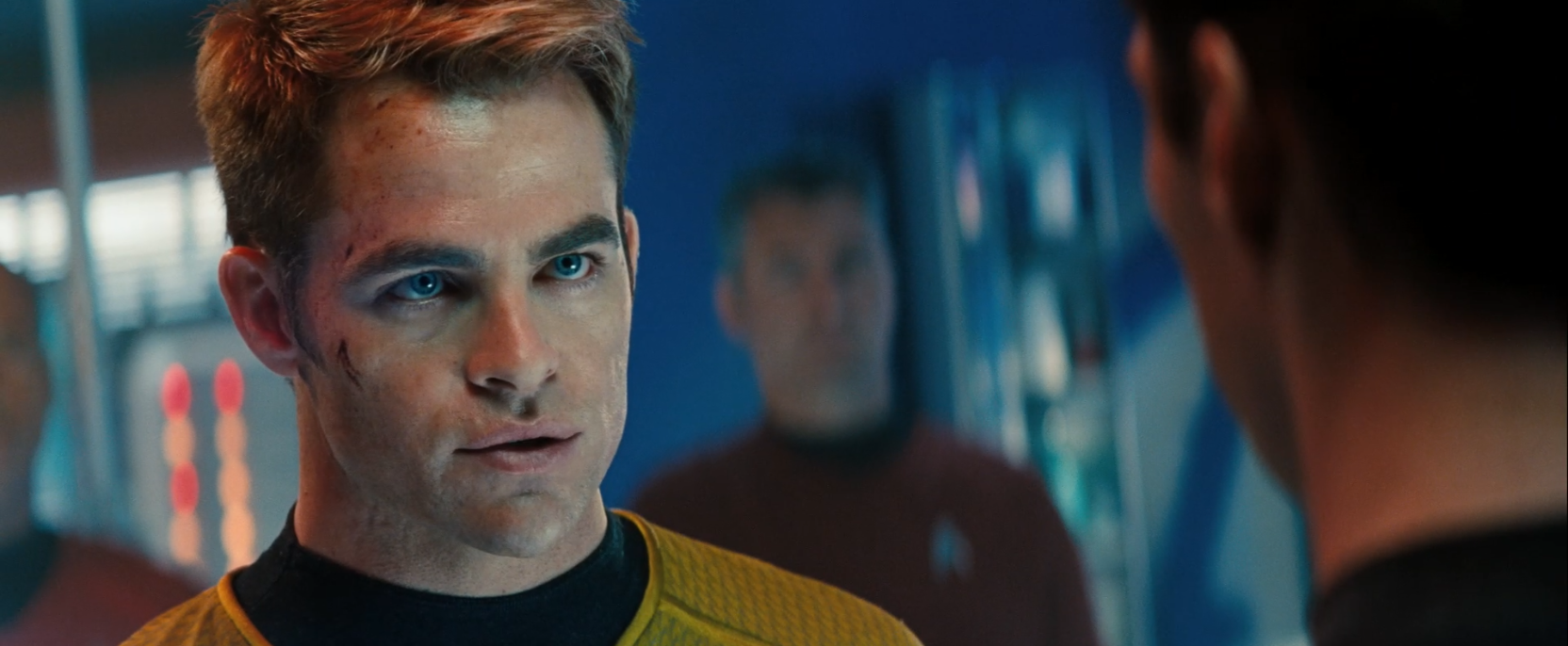
Now, in the first Star Trek, Kirk has a nice arc. He believably goes from a directionless thrill-seeker into the de-facto Captain of the Enterprise, and (with some coaching) manages to form an unlikely friendship with Spock.
In Star Trek Into Darkness, the theme that screenwriters Alex Kurtzman and Roberto Orci are trying to get across is how the crew of a ship is like a family, and how a captain must put his crew/family above himself. This is (clumsily) reflected in the film's villain Khan, and it is emphasized in a few key scenes involving Kirk, especially his "heroic sacrifice" in the third act. Kirk is meant to transform from a somewhat reckless starship captain into a selfless hero.
However, this emotional change rings hollow. The film opens with a scene where Kirk rescues Spock (and jeopardizes the Prime Directive in doing so.) Kirk puts his career on the line to save his friend. So, if his journey is supposed to be one towards selfless heroism, he doesn't really have far to go. He's already heroic and selfless. Then, Kirk is spurred to reckless action by the death of his mentor, Admiral Pike. For the next hour of the film, his motivations are apparently revenge. It's only at the climax of the film that the theme of selfless heroism rears its head.
SPOILERS AHEAD
When the Enterprise's warp core has been damaged, Kirk selflessly enters it himself and repairs it at the cost of his own life by radiation poisoning. He lives just long enough to say a tearful goodbye to Spock. This should be an emotionally powerful moment, but it rings hollow for two reasons:

1) Plot holes. Why, aside from convenience and thematic relevance, is Kirk the one to fix the reactor? There's a whole ship's worth of engineers, any one of whom is more qualified to fix the damn thing than Kirk. Why would Scotty waste precious time jawing with the captain instead of sending a team in to fix the damn thing?
Even leaving aside that plot hole, the more important problem, dramatically speaking, is that
2) Kirk's heroic sacrifice is meaningless.
This sacrifice is something we expect from Kirk because he's already proven himself, over the course of this movie and the one before, to be a take charge, morally upright character who is willing to make sacrifices for the greater good. It doesn't seem out of character for him, nor does it seem like a leap that he would do this. Now, if Kirk had started out the film as a captain willing to sacrifice his crew members' lives, and who had a change of heart - that would be a meaningful emotional change, but this is not.
Furthermore, there aren't really any scenes in between the beginning and end of the film that explore or justify Kirk's character, so as a result he feels flat and underdeveloped.
Last but not least - Kirk's death feels hollow because it's undone pretty much right away. Unlike the tragic death of Spock in Wrath of Khan (which Into Darkness slavishly imitates), Kirk's death is so impermanent it doesn't even last until the end of the movie. So he didn't actually sacrifice anything.
And Kirk is not the only underdeveloped character. Khan suffers a similar fate, but in this case it's because the screenwriters put the audience through emotional whiplash regarding Khan.

In the first half hour of Star Trek Into Darkness we are meant to revile Khan. It's revealed that he's murdered hundreds of people, and we see him kill at least one character (Pike) who we actually like. Then, at around the mid-point of the film, it's revealed that Khan's actions have been largely justified. He's been held hostage by an evil Starfleet Admiral, with his crew's lives at stake if he doesn't co-operate. These motivations actually seem pretty justifiable, and since Khan then teams up with the crew of the Enterprise to fight the evil Admiral, we the audience get on board with Khan.
Then, at the film's climax, he turns evil again, essentially for no reason except that the original Khan was a bad guy in the Shatner/Nimoy timeline. Moreover, for a guy who we are told is a master of strategy and tactics - Khan doesn't seem to have any kind of plan except "shoot the Enterprise with my big scary ship."
His betrayal is supposed to be a shocking and frightening moment, but it rings false because we have been rooting for Khan for a large chunk of the movie. His betrayal comes out of nowhere - he has no real beef with Kirk or Spock. Furthermore (and most damning) we never see Khan do anything completely evil.
He blows up a Starfleet library and kills a bunch of faceless admirals - but that can be justified by his horrific treatment at the hands of Starfleet, and his desperation to rescue his crew.
He kills a bunch of Klingons (who are basically Star Trek Orcs in this film) and saves the heroes while he does it.
He kills Admiral Marcus, the evil warmonger who is responsible for Khan's incarceration.
Okay, sure, he smacks around Kirk and Spock, but that can be justified by self defence.
The only evidence we have that Khan is evil is that Old Spock tells us so. Which is a) a massive cheat on the part of the writers and the characters, and b) sloppy writing. Pretty much the first axiom every writer is taught is show, don't tell. Which means that rather than telling the audience something is true, show them evidence of it and let them draw their own conclusions. If we saw Khan murdering the crew of the Enterprise or eating babies or something, we'd be much more willing to accept him as a villain. If we saw evidence of a dastardly scheme, we'd be much more willing to accept him as a master strategist.
Imagine how much stronger the film would be if Khan tricked the crew of the Enterprise into giving him back his crew, and then warped away, leaving Kirk and Spock to deal with the fact that they just unleashed the equivalent of Space-Hitler on an unsuspecting universe. It would show that Khan was a force to be reckoned with, rather than just asking us to believe one old guy with pointy ears.
This is just the most pertinent example from this summer, but it is certainly not the only example of a blockbuster with underdeveloped characters.

Man of Steel also has this problem. Obviously the film-makers intended for Clark to have an arc, but I'll be damned if I can figure out what it is. He spends most of the movie moping around and brooding, and then hops into a blue and red spandex suit for not much reason. Regrettably, scenes of the character being angst-ridden do not a meaningful arc make. Now, if those scenes are strung together in a sequence, and we see the character's progression from one state of mind to another …
And don't get me started on the characterization of General Zod, who despite Michael Shannon doing his bug-eyed best, is utterly flat and boring, devoid of motivation or personality.
It seems to me that a lot of these big summer tentpoles (especially the ones that are more 'written by committee) think that an audience is willing to sit by and accept these sorts of lacklustre characterizations. However, I don't think that's true, as Man of Steel performed under expectations, while Iron Man 3 (whose main character does have an arc) is one of the most financially successful films ever made.
So, next time (which will follow a lot closer on the heels of this entry, we will be talking about
Insufficiently scary villains, which I feel is a HUGE problem in modern day blockbusters.

No comments:
Post a Comment